

UGC creators sign more contracts in 2026 than any point before it, and most of those contracts still leave usage rights, kill fees, or exclusivity windows blank or buried in dense clauses. This guide ranks the five real paths to a usable UGC contract — free templates, attorney-drafted agreements, platform marketplace paperwork, and AI-reviewed drafts — so you know which one fits your deal size before you sign anything.
- The best UGC contract templates in 2026 pair a written template with a Clarity Score check before you sign.
- Attorney-drafted contracts win for exclusive or high-budget deals; free templates work for first-time creators testing UGC.
- Every usable UGC contract template spells out usage rights, payment terms, and a kill fee clause in plain language.
- Black X does not write contracts — it scores the risk in whatever brief or draft you already have.
- Platform Creator Marketplace agreements favor the platform's standard terms, not necessarily yours.
Why this matters
A UGC contract with vague usage rights language can let a brand run your face in paid ads for years without another payment. That's not a hypothetical — it's the single most common gap creators bring to a contract review, ahead of payment terms or deliverable counts.
Most "best UGC contract template" searches assume one document solves the problem. It doesn't. The right choice depends on deal size, whether you're negotiating directly or through a platform, and whether you have someone checking the fine print before you sign. Black X's brand deal contract guide breaks down the clauses that show up in almost every UGC agreement — this page ranks the template paths themselves.
Running a contract through a tool like Black X before signing catches missing exclusivity windows and undefined kill fees in minutes, regardless of which template you started from.
What makes the best UGC contract template
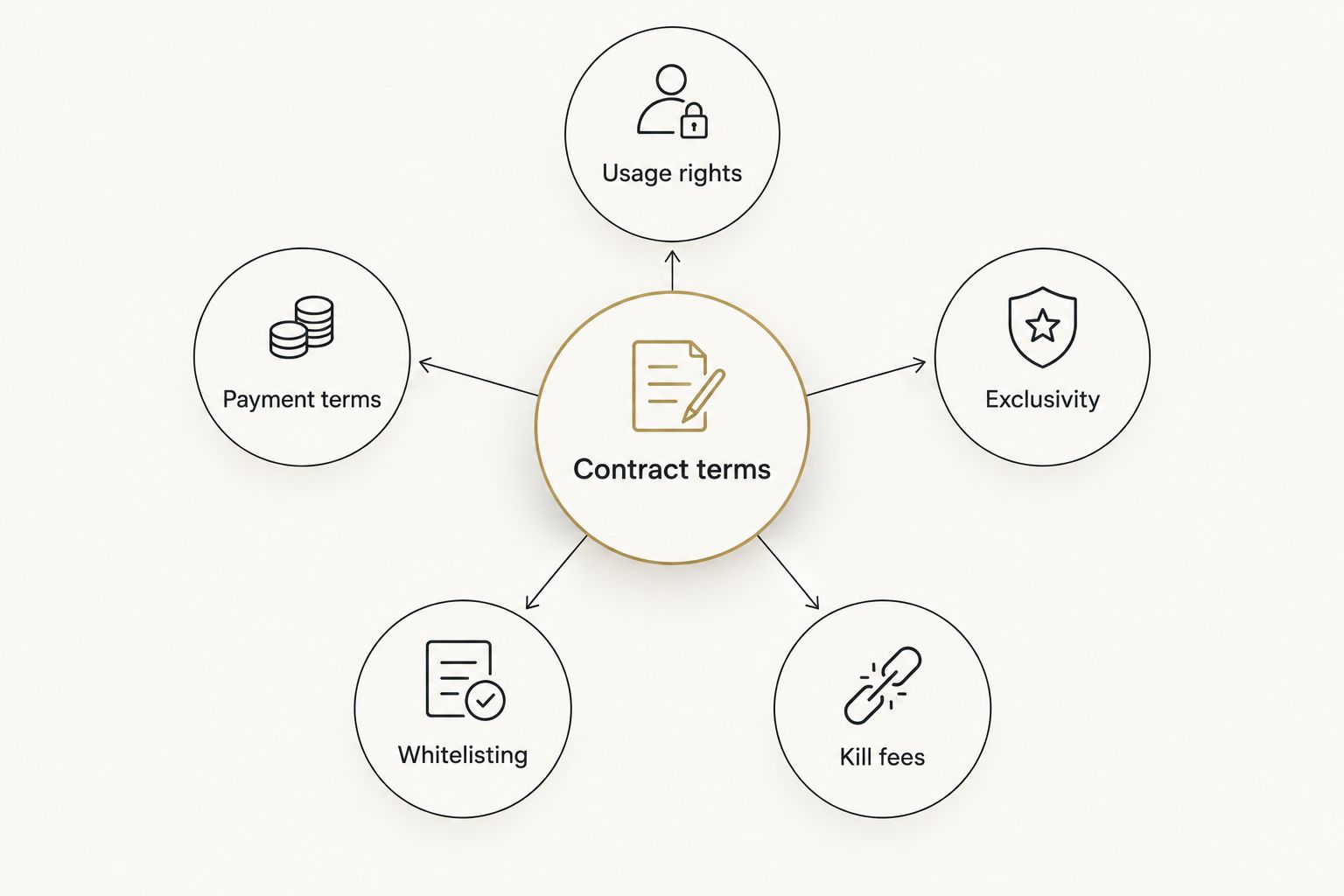
A UGC contract template earns a spot on this list only if it addresses these terms clearly, not just deliverables and deadlines:
- Usage rights — which platforms, for how long, organic only or paid too
- Payment terms — invoice timing, net-30 vs. upon delivery, late payment language
- Exclusivity — how long you can't work with competing brands, and how narrow "competing" is defined
- Whitelisting — whether the brand can run your content as a paid ad under its own handle
- Kill fees — what you're owed if the brand cancels after you've started work
- Revision limits — how many rounds of edits are included before extra work costs extra
At a glance: best UGC contract templates in 2026
| Template type | Best for | Standout feature | Key limitation |
|---|---|---|---|
| Free template + Clarity Score review | Solo creators drafting their own UGC deal | AI-flagged risk before signing | Doesn't draft new contract language for you |
| Attorney-drafted custom contract | High-budget or exclusive brand deals | Terms negotiated to deal size | Slower turnaround, costs scale with complexity |
| Platform Creator Marketplace agreement | Creators sourcing deals through platform tools | Built into the platform's deal flow | Terms usually favor the platform's standard |
| Free downloadable generic template | First-time UGC creators testing the work | Free, ready to send same day | Usually skips usage rights and kill fee clauses |
| Retainer / Master Service Agreement | Creators with repeat brand partners | One agreement covers months of deliverables | Needs legal setup before first use |
1. Free UGC Template + Clarity Score Review: best for solo creators drafting their own deal
Download a free UGC contract template, fill in your deliverables and rate, then run the finished draft through an AI contract review software tool before you send it. The template covers structure; the review flags what's missing.
Pros:
- Costs nothing beyond the review itself
- Flags missing usage rights duration, exclusivity length, and payment terms before signing
- Works with any contract format, not just a specific drafting tool
Cons:
- The review scores risk — it doesn't write contract language for you
- Not a substitute for legal advice on complex or high-dollar deals
- Requires you to already have a draft or brand offer in hand
Best for: Creators who negotiate their own UGC deals and want a second read before signing. Verdict: Buy — pair a free template with a risk check every time.
Score Your UGC Contract Before You Sign
Upload the brief or draft and see where the risk sits.
2. Attorney-Drafted Custom Contract: best for high-budget or exclusive brand deals
A retained attorney writes terms matched to your specific deal — exclusivity scope, whitelisting windows, and kill fee amounts sized to the contract value, not a generic percentage.
If a UGC contract doesn't name a usage rights duration, assume the brand can run your content in ads indefinitely.
“If a UGC contract doesn't name a usage rights duration, assume the brand can run your content in ads indefinitely.”
Pros:
- Terms are negotiated to your deal, not a fill-in-the-blank template
- Handles complex exclusivity and whitelisting language
- Someone represents you if a dispute happens later
Cons:
- Turnaround takes longer than a template you send the same day
- Overkill for a single low-budget UGC video
- Cost scales with how complicated the deal terms are
Best for: Creators negotiating exclusive, multi-month, or high-value UGC and whitelisting deals. Verdict: Buy for high-stakes deals, Skip for a one-off low-budget video.
3. Platform Creator Marketplace Agreement: best for creators sourcing deals through platform tools
When a brand books UGC through a platform's built-in marketplace, the platform issues its own standard agreement automatically. You get a contract without negotiating one.
Pros:
- No negotiation needed to start working
- Payment routes through the platform, reducing payment-chasing risk
- Familiar format if you already source work through that marketplace
Cons:
- Usage rights and whitelisting terms are usually fixed, not negotiable
- Exclusivity clauses can be broader than a custom contract would allow
- Kill fee language is often thin or absent entirely
Best for: Creators who source most UGC work through a platform marketplace rather than direct outreach. Verdict: Hold — use it, but read the usage rights and exclusivity sections closely before accepting.
4. Free Downloadable Generic Template: best for first-time creators testing the work
Generic Word or Google Docs UGC templates circulate widely online. They cover deliverables and deadlines but rarely address platform-specific usage rights or kill fees by default.
Pros:
- Free and ready to send the same day
- Better than working with no written agreement at all
- Easy to edit deliverable and deadline sections yourself
Cons:
- Usually skips usage rights duration and platform scope entirely
- No kill fee or exclusivity language built in
- No risk review before you sign
Best for: Creators doing their first paid UGC deal who need something in writing today. Verdict: Wait — fine for a first deal, but add a risk review before repeating it.
5. Retainer / Master Service Agreement Template: best for creators with repeat brand partners
A Master Service Agreement covers the ongoing relationship once, with individual statements of work for each new deliverable. It's built for creators who get recurring briefs from the same brand.
Pros:
- One signed agreement covers months of recurring UGC content
- Payment terms and kill fees are set once, not renegotiated per video
- Cuts contract admin for both sides on repeat work
Cons:
- Needs legal setup before the first statement of work goes out
- Locks both sides into terms that are harder to renegotiate mid-contract
- Not worth setting up for a single one-off video
Best for: Creators with a brand partner sending recurring monthly UGC briefs. Verdict: Buy if you have several months of confirmed work with the same brand, Skip for one-off deals.
How we ranked these
Each template path was weighed against the same six terms from the criteria section above: usage rights clarity, payment terms, exclusivity scope, whitelisting language, kill fee inclusion, and revision limits. A template that structures deliverables well but leaves usage rights or kill fees undefined ranks lower here than one that's shorter but complete on those points. Cost and turnaround time factored into the "best for" label, not the ranking itself.
Which UGC contract template should you choose?
For most solo creators doing one-off UGC deals in 2026, the free template plus a Clarity Score review wins — it costs nothing beyond the review and catches the clauses that actually cause disputes. Move to an attorney-drafted contract once a single deal crosses into exclusive or high-value territory, and set up a Master Service Agreement the moment a brand starts sending you monthly briefs instead of one-off requests. Skip the platform marketplace's default terms only if you have leverage to negotiate — most creators don't, so read those clauses twice before accepting.
FAQ
What's the best UGC contract template for beginners in 2026?
A free downloadable template covering deliverables, deadlines, and payment is the fastest starting point for a first UGC deal. Add a risk review before repeating the same template on future deals to catch missing usage rights or kill fee language.
Is a free UGC contract template enough, or do I need a lawyer?
A free template is enough for a single low-budget UGC video, but not for exclusive, whitelisted, or high-value deals. Attorney-drafted terms make more sense once exclusivity length or paid usage rights are on the table.
What should a UGC contract always include?
Usage rights duration and platform scope, payment terms, exclusivity length, whitelisting permission, kill fee amount, and revision limits. A contract missing any of these leaves room for disputes later.
How is a UGC contract different from an influencer contract?
A UGC contract typically covers raw content the brand posts from its own account, while an influencer contract covers content posted from the creator's own account and audience. Usage rights and whitelisting terms differ between the two, so a template built for one doesn't automatically fit the other.
Can Black X write my UGC contract for me?
No. Black X scores the risk and clarity in a contract, brief, or offer you already have — it doesn't draft new contract language. Pair it with a template or an attorney-drafted agreement for the actual document.
What is a kill fee in a UGC contract?
A kill fee is the amount a brand owes you if it cancels a deal after you've started work but before delivery. Many free templates leave this clause out entirely, which means you'd have no guaranteed payment if the brand walks away mid-project.
Do platform Creator Marketplace agreements protect creators?
They protect payment flow more than contract terms — usage rights and exclusivity language in platform-issued agreements is usually fixed to favor the platform's standard, not negotiated per creator. Read those sections before accepting, even though you can't usually change them.
How much should I read into a brand's UGC contract before signing?
Read the usage rights, exclusivity, and kill fee sections in full every time, even on templates you've used before with a different brand. Brands frequently adjust these three clauses between deals while leaving the rest of the document unchanged.
One last thing
The clause creators skip reading most often isn't payment terms — it's usage rights duration. A contract that never states how long a brand can use your content defaults, in practice, to indefinite use, which matters far more than the per-video rate once that content ends up in a paid ad campaign a year later.