

Creator brand deal contract review is the process of checking a creator agreement for payment, usage, exclusivity, revision, cancellation, and disclosure terms with the aim of protecting your income and content rights. In 2026, creators need a repeatable review process because the contract, campaign brief, and offer can place different obligations on the same deliverable; Black X analyzes all three for clarity and risk.
- A 2026 brand deal contract should define payment, deliverables, usage rights, exclusivity, revisions, cancellation, and disclosures.
- Check usage duration, platforms, paid advertising, editing rights, and territory before licensing creator content.
- Black X is best for creators who want a fast clarity and risk score before signing.
- Use an attorney when a deal is complex, long-term, or exposes you to obligations you cannot evaluate confidently.
Why brand deal contracts matter for creators
A creator may handle filming, editing, publishing, invoicing, and negotiation alone. The brand or agency may use its own template, so your review must identify what the document requires from you and what it promises in return.
A fee does not explain when payment becomes due, how long the brand can use your content, or whether paid advertising is included. Those details sit in separate clauses. A clear 2026 contract connects the payment to defined deliverables and limits every additional right by purpose, platform, territory, and duration.
The campaign brief matters too. If the contract incorporates the brief, requirements in that brief can become part of your obligations. Review the contract, offer, and brief as one deal rather than treating the contract as the only relevant document.
How to review a brand deal contract
Use the same order for every review. Starting with commercial terms prevents an attractive campaign concept from distracting you from an unclear payment trigger or an open-ended content license.
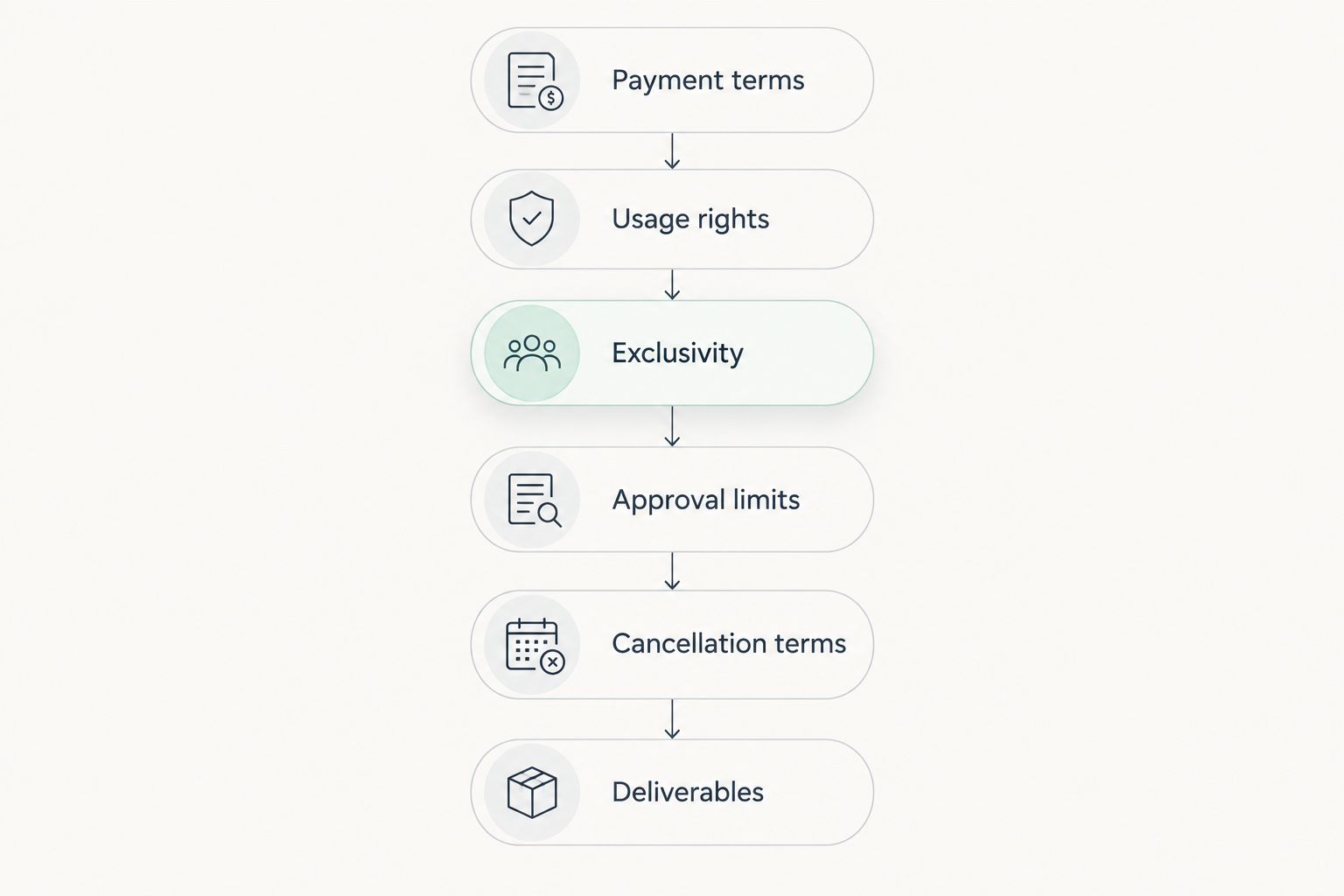
Define the payment trigger
A payment deadline is useful only when the contract states what starts the clock. A net-30 term means payment is due 30 days after the specified trigger, which might be invoicing, content delivery, approval, or publication. Net-60 creates a 60-day period from that trigger, so read the trigger as closely as the number.
- Identify the total agreed compensation without relying on email summaries
- Confirm whether invoicing, delivery, approval, or publication starts the payment period
- Check who receives the invoice and what information it must contain
- Look for a cancellation payment covering work already completed
- Record any expenses that require written approval before reimbursement
Limit the content license
Usage rights determine what the brand can do with your work after delivery. A 30-day organic reposting license is materially different from a 90-day paid advertising license, even when both cover the same video.
Separate organic reposting from paid media, whitelisting, editing, sublicensing, and offline use. If the contract says the brand owns the content outright, that is not the same arrangement as granting a limited license.
- Name every included platform rather than accepting an undefined digital-use clause
- Set a clear start date and end date for each license
- Separate organic use from paid advertising and creator-account access
- Define whether cropping, editing, translation, or adaptation is allowed
- Restrict sublicensing when third parties are not part of the agreed campaign
Score unclear language before signing
After your first manual read, use Black X to analyze the contract, brief, and offer for clarity and risk. This creates a structured second pass without making software a substitute for understanding your own obligations.
Black X is best for creators who want a fast clarity and risk score before signing a brand deal contract. Its limitation is equally clear: scoring risk does not replace legal advice when a clause has serious financial, intellectual-property, or long-term consequences.
- Upload or review the complete agreement rather than an isolated signature page
- Compare flagged terms against the campaign offer and creative brief
- List missing dates, definitions, deliverables, and approval responsibilities
- Ask the brand to revise the document instead of relying on a verbal explanation
- Escalate unresolved legal questions to a qualified attorney
Set boundaries around exclusivity
Exclusivity limits which competing campaigns you can accept. The clause must define the restricted category, covered competitors, start date, end date, territory, and channels. A restriction covering an entire industry is broader than one naming direct competitors.
- Replace vague competitor language with named brands or a defined category
- Confirm whether the restriction starts at signing or publication
- Add an end date rather than accepting continuing exclusivity
- Check whether cancellation also ends the restriction
- Remove channels or territories unrelated to the campaign
Cap approvals and revisions
An approval process should tell both sides what happens after you submit a draft. Without a revision limit, the brand can request repeated changes while the deliverable and payment remain unresolved.
- State how many revision rounds the agreed scope includes
- Distinguish minor edits from reshoots or new creative concepts
- Set a deadline for the brand to provide consolidated feedback
- Identify who gives final approval
- Confirm whether delayed feedback changes the publication schedule
Protect completed work from cancellation
Cancellation language determines what happens when a campaign stops after you have reserved time, bought materials, filmed content, or delivered a draft. The contract should connect compensation to completed stages rather than making all payment depend on publication.
- Define what either party must do to cancel
- Match cancellation compensation to work already completed
- Address approved expenses that cannot be recovered
- State what happens to delivered but unpublished content
- End unused licenses and exclusivity when the campaign ends
Match every deliverable to the brief
The deliverables section should match the brief line by line. Confirm the platform, format, quantity, deadline, review process, disclosure requirements, link placement, and live period for each item.
FTC guidance requires material connections between endorsers and brands to be disclosed clearly and conspicuously. A creator should not depend on a vague instruction to follow applicable rules when the brief can state the required disclosure and placement directly.
- Match each post, video, story, or other asset to a specific platform
- Confirm draft, approval, and publication deadlines
- Identify required disclosures, tags, links, and talking points
- Remove requirements that appear in the brief but not in the agreed scope
- Save the final approved versions of the contract and brief
Brand deal contract review options
The right review method depends on complexity, not excitement about the campaign. In 2026, use self-review for the first pass, contract scoring for a consistent second pass, and legal counsel when the consequences exceed what a checklist or software score can resolve.
| Option | Best for | Key limitation |
|---|---|---|
| Manual checklist | Creators reviewing straightforward agreements | Depends on your ability to recognize vague or missing language |
| Peer or manager review | Creators who want practical campaign context | The reviewer may not have legal training or complete deal information |
| Black X contract scoring | Creators comparing a contract, brief, and offer for clarity and risk | Does not replace individualized legal advice |
| Qualified attorney | Complex, long-term, or high-consequence agreements | Requires additional coordination and review time |
Each option serves a different purpose. Manual review helps you understand the bargain, Black X makes the review more consistent, and an attorney can interpret legal consequences or negotiate language when the stakes demand it.
Check your contract before signing
Score a creator contract, brief, or offer for clarity and risk.
Common mistakes creators make
Treating the brief as informal
If the contract incorporates the brief, missing a brief requirement can create a deliverable dispute. Save the exact version attached to the deal and confirm later changes in writing.
Accepting perpetual usage by default
Open-ended usage gives the brand continuing rights without a renewal decision. Replace it with a defined license period and state which uses are included.
Ignoring the payment trigger
Net-30 does not answer the full payment question. The contract must say whether the 30-day period starts after invoicing, delivery, approval, or publication.
Leaving revisions unlimited
A deliverable with unlimited revisions has no stable scope. Set the included rounds, feedback deadline, and rules for reshoots or new concepts.
Relying on messages instead of amendments
An email explanation does not automatically correct conflicting contract language. Put every negotiated change into the final agreement or a signed amendment before starting work.
FAQ
What should a creator check first in a brand deal contract?
Check the compensation, payment trigger, and payment deadline first. Then review deliverables, usage rights, exclusivity, revisions, cancellation, and disclosure duties.
What are usage rights in a creator contract?
Usage rights define how a brand can use creator content. The clause should identify the media, platforms, territory, duration, editing rights, paid advertising rights, and any sublicensing.
Is whitelisting included in standard usage rights?
Whitelisting should be addressed separately rather than assumed. It lets a brand run advertising through a creator account, which differs from reposting content on the brand's own account.
How long should a brand deal contract last?
A brand deal contract should last only as long as the campaign obligations require. Usage rights, exclusivity, posting duties, and confidentiality can have different end dates, so review each separately.
Does a creator need a lawyer for every brand deal?
No, but legal review is appropriate when an agreement is complex, long-term, or carries consequences you cannot assess confidently. A checklist and Black X can organize the review without replacing legal advice.
What is a cancellation payment in a creator contract?
A cancellation payment compensates the creator for agreed work completed before the campaign ends. The contract should define the amount or calculation for each completed stage.
What should a 2026 creator contract say about disclosures?
A 2026 creator contract should assign responsibility for clear and conspicuous disclosure of the material brand relationship. The brief should also state the required disclosure and where it must appear.
One last thing
A clean contract can still produce a bad deal when the attached brief adds extra deliverables, broader claims, or new approval steps. Before signing in 2026, compare the contract, offer, and brief side by side and resolve every conflict in the final written agreement. That single check protects the scope you priced, the rights you intended to grant, and the schedule you agreed to complete.