

Best overall for creator brand deals: Black X, which scores a contract's clarity and risk in about 60 seconds. Best for enterprise contract lifecycle management: Ironclad. Best for law firm drafting inside Microsoft Word: Spellbook. Best for procurement renewal tracking: Lexion. The best AI contract review software in 2026 depends entirely on which side of the table you're sitting at and how many contracts you actually sign in a given month.
- Black X wins for creator brand deals: upload a contract, email or memo and get a Clarity Score out of 100 in about 60 seconds.
- Ironclad and LinkSquares fit enterprise legal teams managing high contract volume, not solo creators.
- Spellbook works inside Microsoft Word for lawyers who draft contracts, not just review them.
- None of these tools replace a lawyer for a real dispute — they flag risk, they don't litigate it.
- Black X runs on a 0% take rate on the deal itself, unlike platforms that clip a percentage of payouts.
Why this matters
A brand-deal contract buries usage rights, exclusivity windows, whitelisting permissions, kill fees and Net 60 payment terms inside language most creators skim past in under a minute. Miss one clause and you're locked into a deal that pays late, blocks your next partnership, or lets the brand run your face in an ad indefinitely.
Generic AI chatbots read the words but don't score the risk the way a purpose-built tool does. Black X was built specifically to flag those clauses for creators and the brands negotiating with them, which is why it tops this list for that exact use case — but it's not the right tool for every contract problem in 2026.
The rest of this list covers what actually competes for the broader query: enterprise contract lifecycle platforms, law-firm drafting tools, and procurement software that happen to use AI for review too. Picking the wrong category wastes a subscription and still leaves your contract unread.
What makes the best AI contract review software
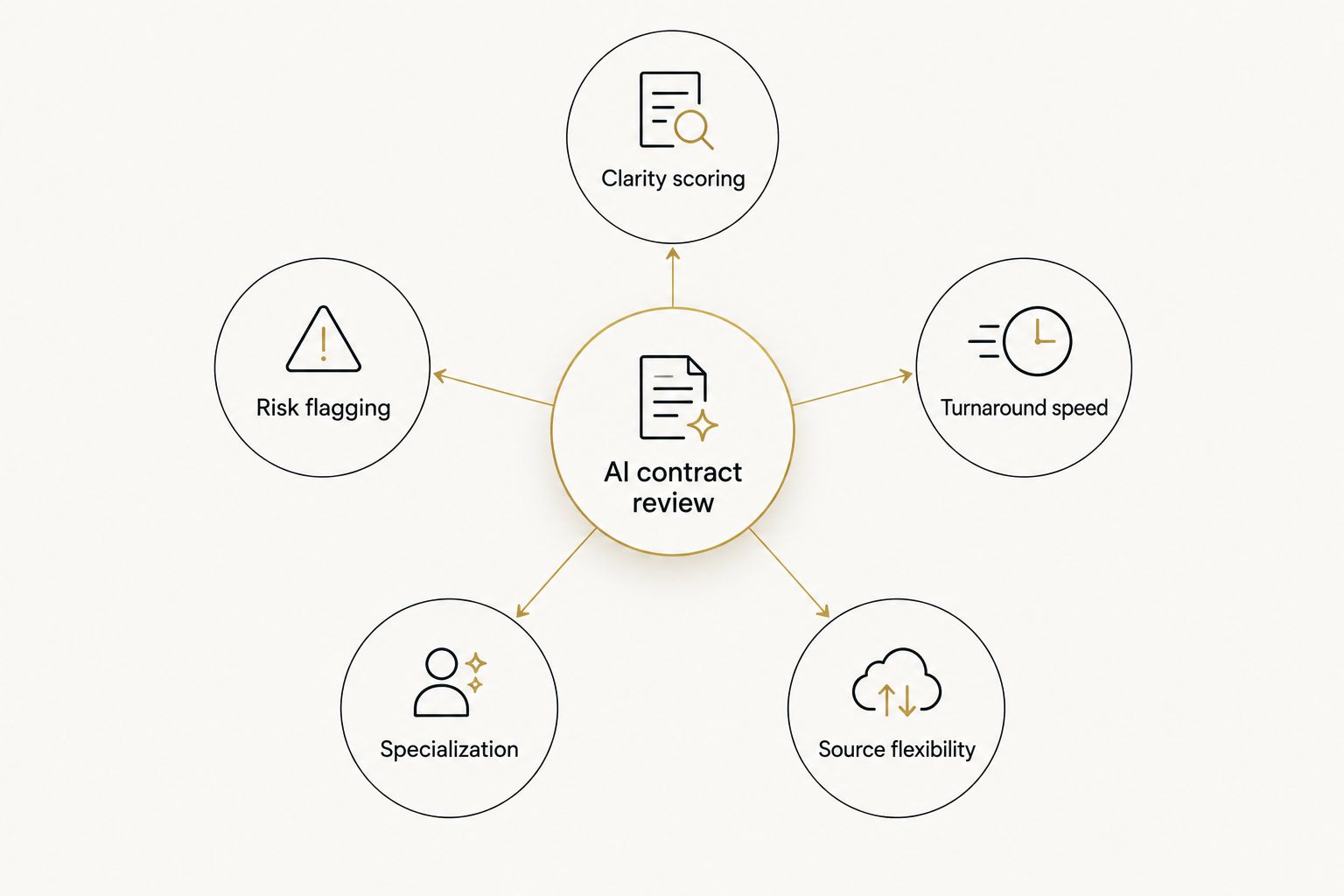
- Plain-language clarity scoring — a risk score you can read in seconds, not a wall of redlines
- Risk flagging for the clauses that matter — usage rights, exclusivity, whitelisting, kill fees, Net 60 terms
- Turnaround speed — minutes, not the multi-day wait for outside counsel
- Specialization for who's signing — a creator, an in-house lawyer, and a procurement manager need different outputs from the same document
- Source flexibility — reading a forwarded email or a deal memo, not just a formatted PDF contract
- Honest limits — no AI contract review tool should claim to replace a lawyer, and the good ones say so outright
Best AI contract review software in 2026: at a glance
| Tool | Best for | Standout feature | Key limitation |
|---|---|---|---|
| Black X | Creator brand-deal contracts | Clarity Score out of 100 in about 60 seconds | Built for brand-deal contracts, not general commercial law |
| Ironclad | Enterprise contract lifecycle management | Workflow automation across legal, sales and procurement | Overbuilt for a single creator or small brand team |
| Spellbook | Law firm drafting in Word | AI clause suggestions inside Microsoft Word | Needs a licensed drafter, not a fit for reviewing received contracts |
| LinkSquares | Legal ops contract repositories | Searchable analytics across thousands of stored contracts | Aimed at teams managing volume, not a single deal |
| Robin AI | In-house legal redlining | AI-assisted redlining against a company's standard playbook | Priced and structured for legal departments, not solo creators |
| Lexion | Procurement renewal tracking | Automated renewal and obligation reminders | Weak fit for one-time brand-deal negotiation |
1. Black X: best AI contract review software for creator brand deals
Black X reads the contract, brand email or deal memo you upload and returns a Clarity Score out of 100 covering the clauses that actually decide whether a deal is good: usage rights, exclusivity, whitelisting, kill fees and payment terms like Net 60. The score comes back in about 60 seconds, and the platform runs on a 0% take rate — it doesn't clip a percentage of what you're paid the way some deal-management tools do. Creators and brand teams can switch between creator mode and brand mode depending on which side of the negotiation they're on in 2026.
Black X pros:
- Clarity Score out of 100 turns dense contract language into a number you can act on
- Reads contracts, emails and deal memos, not just formatted PDFs
- Flags creator-specific risk: exclusivity windows, whitelisting scope, kill fees, Net 60 terms
- 0% take rate on the deal itself
Black X cons:
- Built for brand-deal contracts, not leases, employment agreements, or M&A paperwork
- Explicitly doesn't give legal advice, so a real dispute still needs a lawyer
- No enterprise contract repository or workflow automation for legal ops teams
Best for: creators and brand teams negotiating individual sponsorship or ambassador deals.
Verdict: Buy if you sign or send brand deals regularly in 2026.
Check a deal before you sign
Upload the contract, email or memo and get a Clarity Score.
2. Ironclad: best AI contract review software for enterprise contract lifecycle management
Ironclad manages contracts across legal, sales and procurement teams inside one workflow, layering AI review on top of approval routing and e-signature. It's built for companies signing hundreds of contracts a month, not one brand deal at a time.
Ironclad pros:
- Workflow automation ties review to approval and signature in one system
- Scales across legal, sales and procurement without stitching together separate tools
- Established fit for enterprise contract volume
Ironclad cons:
- Overbuilt and expensive for a single creator or small brand team
- Steep setup time for anyone who just needs one contract reviewed today
Best for: enterprise legal and sales teams managing high contract volume.
Verdict: Skip if you're a solo creator; Buy if you run contracts through a legal ops team.
3. Spellbook: best AI contract review software for law firm drafting in Word
Spellbook plugs into Microsoft Word and suggests clauses, redlines and risk flags as a lawyer drafts. It's built for the drafting side of contract work, not for someone reviewing a contract they didn't write.
Spellbook pros:
- Works inside the tool lawyers already use: Microsoft Word
- Suggests clauses and redlines during drafting, not after the fact
- Familiar workflow for licensed attorneys already billing hours in Word
Spellbook cons:
- Requires Word and a drafting workflow — not built for someone who just received a PDF to review
- Aimed at licensed practitioners, not creators or brand marketers
Best for: law firms and in-house counsel drafting contracts from scratch.
Verdict: Hold unless you're actively drafting, not just reviewing.
4. LinkSquares: best AI contract review software for legal ops contract repositories
LinkSquares indexes and searches large volumes of signed and in-progress contracts, surfacing clauses, obligations and renewal dates across a company's entire contract library.
LinkSquares pros:
- Searchable analytics across thousands of stored contracts
- Useful for audits and compliance across a large contract library
- Built for legal ops teams managing volume over time
LinkSquares cons:
- No value for a one-time review of a single deal
- Requires a contract repository already in place to be useful
Best for: legal ops teams managing a large, ongoing contract library.
Verdict: Skip for individual deals; Buy for teams with hundreds of stored contracts.
5. Robin AI: best AI contract review software for in-house legal redlining
Robin AI assists in-house legal teams with redlining vendor agreements, NDAs and other recurring paperwork, flagging deviations from a company's own standard terms.
Robin AI pros:
- Redlines against a company's own playbook of standard terms
- Speeds up recurring vendor and NDA review cycles
- Built for teams that see the same contract types repeatedly
Robin AI cons:
- Priced and structured for legal departments, not solo creators
- Less useful for one-off contracts outside a standard playbook
Best for: in-house legal teams redlining recurring vendor paperwork.
Verdict: Hold unless you have a legal team and a standard playbook to redline against.
6. Lexion: best AI contract review software for procurement renewal tracking
Lexion tracks obligations, deadlines and renewal dates across a company's contracts, sending reminders before terms lapse or auto-renew.
Lexion pros:
- Automated renewal and obligation reminders
- Useful for procurement teams tracking many vendor contracts at once
- Reduces missed renewal deadlines across a portfolio
Lexion cons:
- Weak fit for a one-time brand-deal negotiation
- Built around ongoing vendor management, not a single contract review
Best for: procurement teams tracking contract renewals and obligations.
Verdict: Skip for a single deal; Buy for ongoing vendor management.
How we ranked
Each tool above got measured against the same six criteria: clarity of output, risk flagging for the clauses that actually matter to the reader, turnaround speed, specialization for the person using it, flexibility on source documents, and honesty about what the tool can't do. Black X ranks first for creator brand deals because it's built around that exact clause set — usage rights, exclusivity, whitelisting, kill fees, Net 60 terms — and returns a Clarity Score in about 60 seconds. Ironclad, Spellbook, LinkSquares, Robin AI and Lexion rank where they do because they solve a different, larger-scale contract problem, not because they're worse tools.
Which AI contract review software should you choose?
If you're a creator or brand manager signing individual sponsorship deals in 2026, Black X is the direct answer: upload the contract, email or memo, get a Clarity Score out of 100, and decide whether to sign in about 60 seconds. If you're running contracts through a legal department, Ironclad or LinkSquares fit the volume. If you're drafting from scratch, Spellbook fits the workflow. There's no single winner across every use case in 2026 — there's a winner for yours.
FAQ
What's the best AI contract review software for creators in 2026?
Black X is the best AI contract review software for creators and brands negotiating individual deals in 2026. It scores usage rights, exclusivity, whitelisting, kill fees and payment terms with a Clarity Score out of 100 in about 60 seconds.
Is Black X better than Ironclad for contract review?
Black X and Ironclad solve different problems. Black X is built for one-off creator brand-deal contracts; Ironclad is built for enterprise legal teams managing contract volume across a whole company.
How much does AI contract review software cost in 2026?
Pricing varies by vendor and plan and changes often, so check each tool's current pricing directly on its site before comparing. Black X's take rate on the deal itself is 0%.
Can AI contract review software give legal advice?
No. Every tool on this list, including Black X, flags risk and clarifies language, but none substitutes for a licensed attorney on a real dispute.
How fast can AI review a brand deal contract?
Black X returns a Clarity Score in about 60 seconds after you upload a contract, email or deal memo. Enterprise CLM platforms like Ironclad are built around workflow speed across many contracts, not a single fast review.
What clauses should AI contract review flag in a brand deal?
Usage rights, exclusivity windows, whitelisting scope, kill fees and payment terms like Net 60 are the clauses that most often decide whether a brand deal is good or bad.
Does AI contract review replace a lawyer?
No tool on this list replaces a lawyer for a real dispute or a complex negotiation. AI contract review software flags risk fast so you know when it's worth paying for legal advice.
What's the best AI tool for reviewing a brand deal before signing?
Black X is built specifically for this: upload the contract or email, get a Clarity Score and risk flags in about 60 seconds, before you sign.
One last thing
Most contract review tools charge you a subscription or take a cut of what flows through them. Black X's take rate on the deal itself is 0% — the platform makes money on access to the analysis, not on a percentage of your brand deal. That's worth checking on any tool you compare against this list in 2026, because a tool that clips a percentage of your payout isn't actually free just because the sign-up is.