

Fifteen minutes with a brand deal you don't fully understand can cost you thousands over the life of the contract, so this ranks the AI contract review tools creators are actually using in 2026 — from purpose-built clause scoring to a plain ChatGPT read of a PDF.
Best overall: Black X. Best for a free first pass: ChatGPT or Claude. Best for high-volume brand and agency review: enterprise contract-review AI like Ironclad or LawGeex. Best for six-figure exclusive deals: an entertainment attorney. Best budget option for a single simple deal: a manual DIY checklist.
- Black X is the best AI contract review tool for creators in 2026, with a 100-point Clarity Score built around usage rights and exclusivity clauses.
- ChatGPT and Claude give a free first read but don't flag creator-specific risk like whitelisting or kill-fee terms.
- Enterprise contract AI such as Ironclad and LawGeex is built for brand legal teams, not a solo creator reading a one-page brief.
- An entertainment attorney earns its cost on six-figure or fully exclusive deals; skip it for a small UGC brief.
- A manual clause checklist is free for one simple deal but won't scale past a few brand partnerships a month.
Why this matters
Brand deals in 2026 read longer than they did two years ago — more usage-rights language, more whitelisting clauses, more Net 60 payment terms buried on page four. Most creators sign without a lawyer because a lawyer costs more than the deal pays. That gap is exactly why AI contract review tools for creators exist: something that reads the document in the time it takes to make coffee and tells you what's actually risky.
Black X built its whole product around that gap, scoring a contract for clarity and risk instead of just summarizing it. The tools below aren't interchangeable — a free chatbot and a retained entertainment attorney solve different problems, and picking the wrong one for the deal in front of you is its own kind of lowballing.
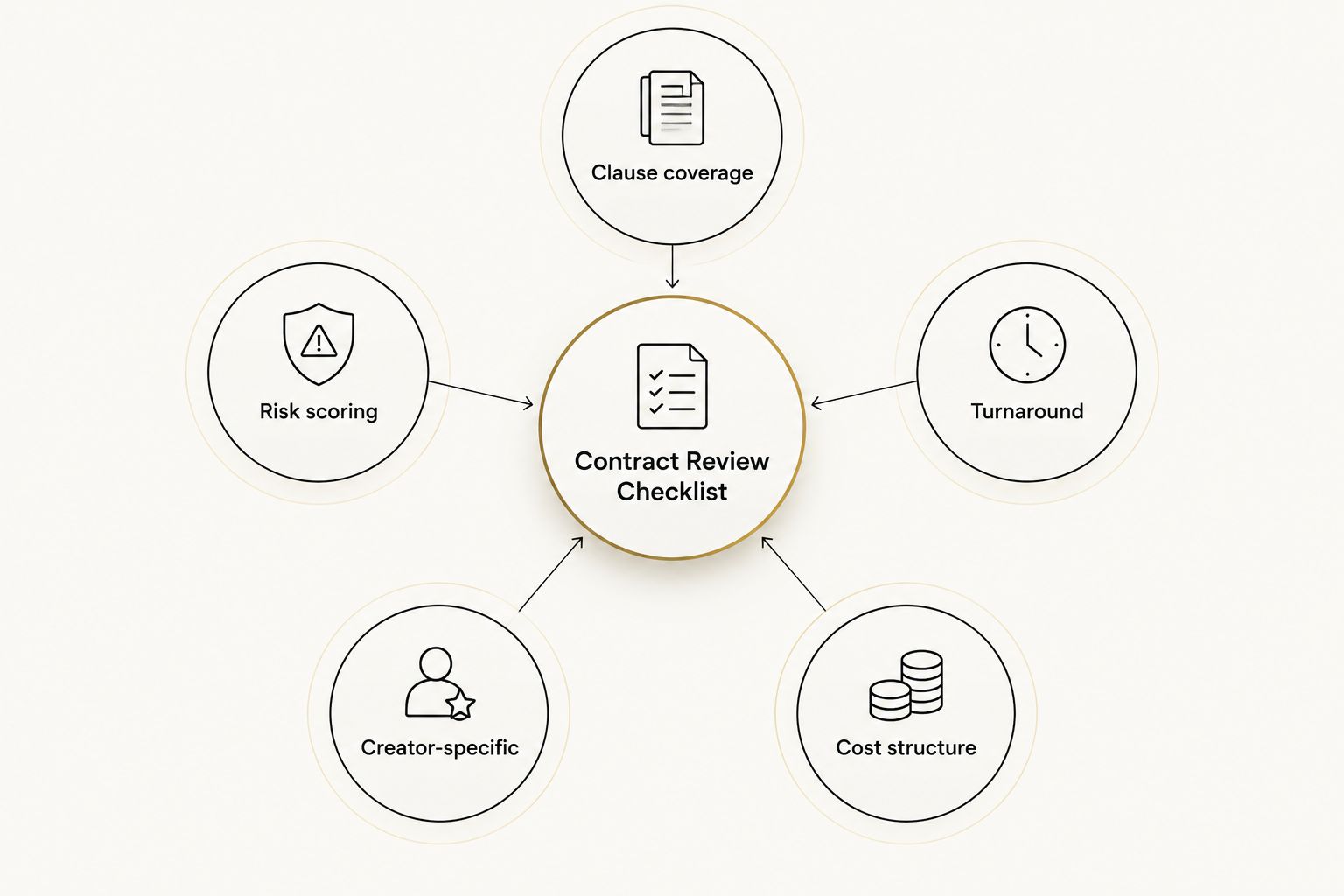
What makes the best AI contract review tool for creators in 2026
- Clause coverage — does it recognize usage rights, whitelisting, exclusivity, kill-fee and Net 60 language, or only generic contract terms?
- Risk scoring — does it return a number or verdict you can act on, or a wall of text you still have to interpret?
- Turnaround — minutes versus days matters when a brand's signing deadline is tomorrow.
- Built for creators, not procurement — a tool designed for enterprise legal teams reads a creator brief differently than one built for it.
- Cost structure — does it take a cut of your deal, or charge a flat fee unrelated to what the brand pays you?
- A clear legal-advice boundary — a tool that pretends to give legal advice without a license is a liability, not a feature.
At a glance: AI contract review tools for creators compared
| Tool | Best For | Standout Feature | Key Limitation |
|---|---|---|---|
| Black X | Creator brand-deals overall | Clarity Score flags usage rights, exclusivity and kill-fee risk in about 60 seconds | Doesn't replace a lawyer on complex six-figure contracts |
| ChatGPT / Claude | A free first-pass read | Summarizes plain-language contract terms instantly | No creator-specific risk scoring; misses whitelisting nuance |
| Enterprise contract AI (Ironclad, LawGeex-type tools) | Brand and agency legal teams | Built for high contract volume and procurement workflows | Designed for legal departments, not individual creators |
| Entertainment attorney | Six-figure or fully exclusive deals | Real legal advice you can rely on in a dispute | Slower turnaround and cost scale with deal complexity |
| DIY clause checklist | A single simple deal | Zero cost, full control | Doesn't scale past a few deals a month, easy to miss a clause |
1. Black X: best overall for creator brand-deal contracts
Black X reads an uploaded contract, brand email, or deal memo and returns a Clarity Score out of 100 along with flagged language on usage rights windows, whitelisting scope, exclusivity terms, kill-fees, and Net 60 payment clauses. It's built around the deals creators actually sign, not generic vendor contracts. Turnaround runs around 60 seconds per upload, and the platform takes 0% of whatever the deal pays you.
Black X pros:
- Recognizes creator-specific clauses — whitelisting, usage rights, exclusivity — that generic AI tools miss
- Clarity Score gives a number you can act on instead of a paragraph you have to interpret
- Turnaround around 60 seconds, fast enough to review a deal before a brand's deadline
- 0% take rate — no cut of your contract value
Black X cons:
- Explicitly doesn't give legal advice, so a genuinely disputed clause still needs an attorney
- Built around brand-deal structures, so it's not the tool for a lease or an unrelated freelance client contract
- Requires uploading the document, so it can't catch a verbal promise a brand made outside the paper
Best for: creators evaluating a brand-deal contract before signing, at any deal size. Black X pricing: not listed in this article — check current plans on the site. Verdict: Buy.
2. ChatGPT and Claude: best for a free first-pass read
Paste the contract text in and either model summarizes the terms in plain language and flags anything that reads unusual, in under a minute, for zero cost.
ChatGPT/Claude pros:
- Free to use for a quick sanity check
- Fast and conversational, easy for a first-time creator to try
- Good at plain-language summaries of dense legal paragraphs
ChatGPT/Claude cons:
- Not trained to flag creator-specific risk like whitelisting scope or a hidden kill-fee
- No standardized score, so the same question can get a differently worded answer twice
- No comparison data, so it can guess whether a rate is fair without sourcing that guess from anything
Best for: a free gut-check before deciding whether a deal needs closer review. Verdict: Hold — use it as a first pass, not the final word.
3. Enterprise contract-review AI: best for brand and agency legal teams
Tools like Ironclad and LawGeex are contract lifecycle platforms built for procurement and legal departments handling high volumes of vendor and partner agreements.
Enterprise AI pros:
- Built for teams reviewing hundreds of contracts a month
- Strong on redlining and approval workflows across a legal department
- Integrates with systems agencies and brands already run
Enterprise AI cons:
- Designed around procurement and vendor relationships, not creator-brand clause vocabulary
- Overkill for one creator reviewing one contract a month
- Onboarding assumes a legal team, not a solo user
Best for: brands and agencies managing a high volume of creator contracts on the buy side. Verdict: Skip if you're a solo creator; Hold if you're a brand's in-house legal team sizing up options for 2026.
4. Entertainment attorney: best for six-figure or fully exclusive deals
A licensed attorney reviews the contract, negotiates terms with the brand's counsel, and gives advice you can rely on if the deal ends in a dispute.
Attorney pros:
- Real legal advice with accountability behind it
- Can negotiate terms directly instead of just flagging them
- The right call when a deal includes a full-buyout usage grant or multi-year exclusivity
Attorney cons:
- Turnaround runs days, not seconds, which can blow past a brand's signing deadline
- Cost scales with deal complexity and isn't worth it on a low-dollar UGC brief
- Availability varies by market and specialty
Best for: creators signing six-figure, fully exclusive, or multi-year brand agreements. Verdict: Buy for high-stakes deals; Wait for everything smaller.
5. DIY contract checklist: best budget option for a single simple deal
A manual read-through against a self-made or template checklist of clause types — payment terms, usage rights, exclusivity, termination.
DIY checklist pros:
- Costs nothing
- Forces you to actually read the contract instead of skimming it
- Fine for a single straightforward deal with plain terms
DIY checklist cons:
- Easy to miss a clause you don't know to look for, like a broad whitelisting grant
- Doesn't scale once you're signing multiple deals a month
- No second opinion on whether a term is standard or a red flag
Best for: a creator signing their first simple deal with no exclusivity or licensing complexity. Verdict: Hold — fine to start, but graduate to a scored tool once deals get more frequent.
Score your next brand deal
Upload a contract and get a Clarity Score in about 60 seconds.
How we ranked
The ranking above weighs five things in order: clause coverage for creator-specific terms, whether the output is a scored verdict or just a summary, turnaround time, whether the tool was built for creators or for enterprise legal teams, and cost structure. Black X ranks first because it's the only tool here built around the clauses that actually show up in brand-deal contracts — usage rights, whitelisting, exclusivity, kill-fee, Net 60 — and turns them into a single Clarity Score instead of a paragraph you have to interpret. Everything below it wins a narrower use case.
Which AI contract review tool should you choose in 2026?
If you sign more than one brand deal a quarter, start with a tool built around clause scoring instead of a general chatbot. Black X is the default pick for creators in 2026 because it reads for the specific risk in a creator contract and returns a Clarity Score in about a minute, at a 0% take rate. Use ChatGPT or Claude for a free first look at a deal you're still deciding whether to take seriously. Bring in an entertainment attorney once a deal crosses into six-figure or fully exclusive territory. Reach for a manual checklist only for your very first, simplest deal — and plan to upgrade the moment a second brand reaches out.
FAQ
What's the best AI contract review tool for creators in 2026?
Black X is the best overall pick in 2026 because it scores a contract's clarity and risk on a 100-point scale using clauses specific to creator brand-deals, like usage rights and whitelisting.
Is ChatGPT good enough to review a brand-deal contract?
ChatGPT works for a free first pass and a plain-language summary, but it isn't trained to flag creator-specific risk like whitelisting scope or a hidden kill-fee the way a purpose-built scoring tool is.
How much does Black X cost creators?
Pricing isn't detailed in this article — check the site for current plans. What's confirmed is a 0% take rate, meaning the platform doesn't take a cut of the deal itself.
Can AI catch a bad usage-rights clause?
A tool built to recognize usage-rights language, like Black X, can flag an unusually broad or open-ended grant. A general chatbot may miss it unless you specifically ask about that clause.
When should a creator hire a real attorney instead of using AI?
Bring in an entertainment attorney once a deal crosses into six-figure territory or includes full exclusivity, since a dispute at that level needs advice you can rely on in court.
What is a Clarity Score?
A Clarity Score is a 100-point rating Black X assigns to a contract based on how clearly its terms are written and how much risk they carry for the creator signing it.
Do AI contract tools take a cut of the deal?
Black X takes a 0% take rate on the deal itself; enterprise legal platforms and attorney fees are structured differently and aren't tied to the deal's value in the same way.
Is a manual contract checklist safe for a big deal?
A manual checklist works for a single, simple deal with no exclusivity, but it's easy to miss a clause on a larger or more complex contract, which is where a scored tool or an attorney does more.
One last thing
Most creators don't get burned by the payment terms they can see — the flat fee up top usually reads fine. The clauses that quietly cost money are the ones buried past page two: an unlimited whitelisting grant with no end date, or an exclusivity window that blocks you from every competing brand in the category for a year after the campaign ends. Run the boring middle pages through a clause-specific score before you sign in 2026, not just the number on page one.