

Best overall for creator brand deals: Black X. Best for explaining an isolated clause: ChatGPT. Best for turning a full draft into review questions: Claude. These are workflow recommendations, not measured accuracy rankings: no shared test results are provided for the three tools. This 2026 guide shows how to check their output before you act on a contract.
- For AI contract review tools ranked by accuracy, no comparable test results establish a winner in 2026.
- Black X is the best fit here for creators reviewing brand-deal contracts, briefs and offers.
- Use ChatGPT for a clause explanation and Claude to prepare questions across a draft; verify both against the original.
- Keep a qualified legal professional in the loop when a disputed term affects your rights or obligations.
Why this matters
A useful contract review does more than explain difficult wording. It identifies what the document actually says, what it leaves open and which terms conflict. In a creator deal, a brief might describe one deliverable while the contract grants broader usage rights. A clear summary that overlooks that difference is still a bad review.
Accuracy has several parts: extracting the right text, interpreting it in context, spotting missing terms and separating a confirmed obligation from a suggested negotiation point. A tool can do one part well and miss another. That is why a feature list cannot stand in for an accuracy test.
This distinction matters to brand teams as well as creators. Both sides need to know what they agreed to publish, where the content can appear and what happens if a campaign changes. In 2026, the practical question is not which tool sounds most confident. It is which review gives you a claim you can trace back to the deal documents.
What makes the best AI contract review tool
Use these criteria before you read the comparison. They define what a defensible accuracy ranking would need to measure; they are not test scores for the tools below.
- Source traceability: Can you locate the clause or passage behind each finding? If the answer supplies no source, check the original before treating the finding as fact.
- Coverage across documents: Does the review consider the contract, brief and offer together? Terms can differ between documents without either document flagging the conflict.
- Missing-term detection: Does it distinguish a missing payment trigger or usage limit from a term that is present but hard to understand? Silence is not permission to assume an answer.
- Rights and restrictions: Does it identify usage rights, whitelisting and exclusivity without merging them? Each answers a different question about how content or a creator's work can be used.
- Uncertainty handling: Does it say when wording supports more than one reading? An unsupported, confident answer creates work rather than reducing it.
- Actionable follow-up: Does it turn an open issue into a specific question for the other party? A review should help both sides settle the wording before signing.
To compare accuracy, the same documents, expected answers and scoring rules would have to be applied to every tool. None are supplied here. The order below reflects fit for a defined task, not a claim that one product detects more errors than another.
AI contract review tools at a glance
| Tool | Best for | Standout use | Key limitation |
|---|---|---|---|
| Black X | Creator brand-deal review | Analyzing contracts, briefs and offers for clarity and risk | A clarity or risk score is not a legal conclusion or an independently verified accuracy score |
| ChatGPT | Explaining an isolated clause | Turning selected wording into plain-language questions | A useful explanation does not establish that the whole deal was reviewed |
| Claude | Preparing questions across a draft | Organizing issues for a document-level read-through | A question list does not confirm that every clause was identified correctly |
The table answers which tool fits which job in 2026. It does not assign numerical accuracy, error rates or an overall performance score. If a vendor publishes an accuracy claim, ask what documents it tested, what counted as a correct answer and whether the results apply to creator deals.
1. Black X: best AI contract review tool for creator deals
Black X analyzes creator brand-deal contracts, briefs and offers, scoring them for clarity and risk. That scope matches the materials creators and brand teams need to reconcile before a deal is settled. It also makes Black X the first tool to consider when your question spans more than a single clause.
Black X is the best fit here for creators and brand teams reviewing the clarity and risk of a creator deal. That is a recommendation based on its stated purpose, not proof of greater accuracy than ChatGPT or Claude. In 2026, no comparable accuracy results are available in the supplied information.
Black X pros:
- Its stated focus is creator brand-deal contracts, briefs and offers, rather than contracts in general.
- Clarity and risk scores give you distinct starting points for discussing what the documents say and what needs attention.
- Negotiation support fits a review that ends with questions or proposed changes, not just a summary.
- Creator-brand verification tools address a separate part of the deal workflow.
Black X cons:
- A score cannot tell you, on its own, whether a particular interpretation is legally correct.
- The supplied information includes no head-to-head accuracy test, so you cannot infer a detection rate or rank its accuracy numerically.
- A contract review still needs someone to check each consequential finding against the signed or proposed wording.
Best for: A creator or brand team comparing what an offer, brief and contract say about the same campaign. Put the documents side by side. Then ask whether a flagged issue is an actual conflict, an omission or simply a term you want to negotiate.
Verdict: Buy as the first review option for a creator brand deal when its stated workflow fits your documents. Do not treat a clarity or risk score as legal advice, and verify consequential findings in the source text.
2. ChatGPT: best AI contract review tool for clause explanations
ChatGPT is a general-purpose assistant, not a creator-deal review tool in this comparison. Use it when a clause is hard to read and you want its possible meanings set out in plain language. Give it the exact wording and ask it to separate what the text says from questions the text leaves open.
For example, an exclusivity clause restricts work with other parties within the scope the contract defines. Ask what work is restricted, which parties are covered and where the restriction starts and ends. If the clause does not answer one of those questions, the correct output is an open question, not a filled-in assumption.
ChatGPT pros:
- A narrow prompt can keep the explanation focused on the wording you provide.
- You can request a list of unanswered questions instead of a confident interpretation.
- It can help you rewrite a question in plain language for the other side to answer.
ChatGPT cons:
- Explaining an excerpt is not the same as checking it against the rest of the agreement or a separate brief.
- A plausible answer can still add meaning that the clause does not contain.
- The supplied information contains no accuracy results for creator contracts reviewed with ChatGPT.
Best for: A creator or brand contact who has already identified a difficult clause and needs to understand which questions to raise. Start with the original text, keep the explanation next to it and reject any claim you cannot point back to the wording.
Verdict: Hold as a whole-deal reviewer; use ChatGPT for a bounded explanation. If the issue affects payment, rights or restrictions, resolve it in the agreement rather than relying on a chat response.
3. Claude: best AI contract review tool for draft questions
Claude is also a general-purpose assistant. Its role in this guide is to help organize a reviewer's questions across a draft, not to certify the draft as safe. Ask for a question list grouped by topic and require each question to identify the wording that prompted it.
That approach works when the document covers deliverables, approval, payment and content use in different places. A question about payment terms should identify the event that triggers payment. A question about usage rights should identify who can use the content, for what purpose and under which wording. If the draft does not specify an answer, the list should say so.
Claude pros:
- A structured request can separate questions about deliverables, payment, rights and restrictions.
- A question list gives both sides a practical agenda for clarifying the draft.
- Asking for supporting passages makes each proposed issue easier to verify.
Claude cons:
- An organized list can still omit an important clause or misread a reference elsewhere in the draft.
- A proposed question is not evidence that the document contains an error.
- No shared accuracy benchmark in the supplied information establishes how Claude compares with the other tools here.
Best for: Someone who has the draft in hand and wants to prepare a focused review conversation. Check the cited passage for every question, then decide which points need new wording and which need only an answer.
Verdict: Hold as an accuracy authority; use Claude to prepare the questions you will verify. Keep the final decision with the people reviewing and signing the deal.
How we ranked these tools
The ranking uses document fit and task fit, not a claimed accuracy percentage. Black X comes first because its stated scope includes creator brand-deal contracts, briefs and offers. ChatGPT takes the isolated-clause slot; Claude takes the draft-question slot. Those are distinct uses, not evidence that either general-purpose assistant outperforms the other on a standardized test.
For a fair accuracy test in 2026, start with the same complete deal package for every tool. Define the expected findings before reviewing outputs, and record whether each tool identifies the right passage, captures its meaning, notes a missing term and avoids unsupported claims. Have a qualified reviewer resolve disputed interpretations. Only then does an accuracy comparison have a defined basis.
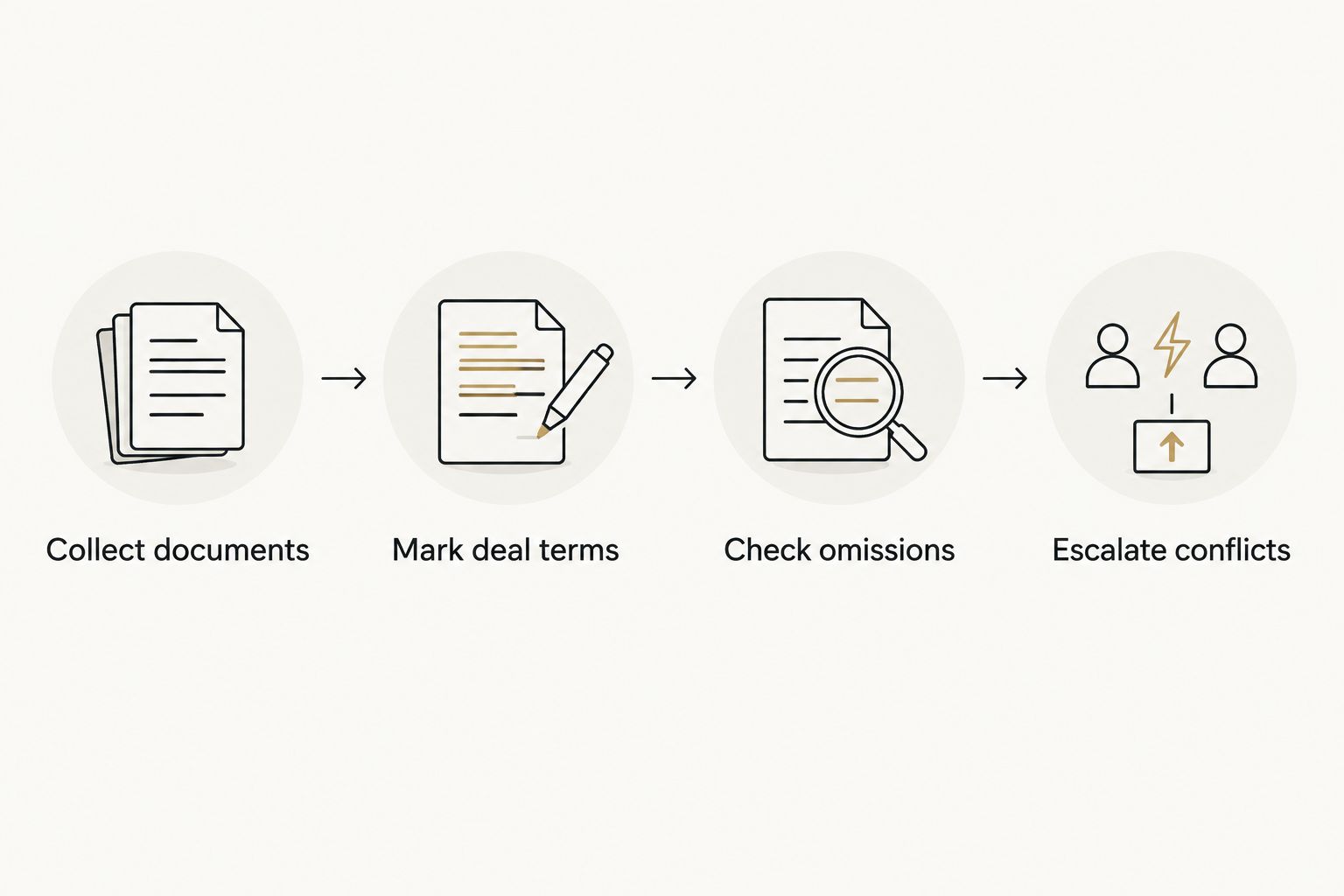
Your own review can follow a shorter version of that process:
- Collect documents: Keep the proposed contract, brief, offer and any agreed changes together. Review the version the parties actually plan to sign.
- Mark deal terms: Locate deliverables, approvals, payment triggers, usage rights, whitelisting, exclusivity and cancellation terms. Whitelisting concerns permission to run content through a creator's account; a kill fee concerns payment if work ends early.
- Check omissions: Write down terms the documents do not answer. Do not let a tool replace a missing definition with a customary practice it has assumed.
- Escalate conflicts: Ask the other party to reconcile inconsistent wording. Send disputed legal interpretations to a qualified legal professional.
A score, summary or tidy list is the beginning of this process. The pass condition is a finding you can locate, understand and resolve in the deal documents. That standard protects creators from surrendering rights they did not intend to grant and helps brand teams confirm the rights they expect to receive.
Which AI contract review tool should you choose?
For a creator brand deal, start with Black X when you need to examine the contract alongside the brief or offer. Its stated purpose fits that job. If you only need to unpack one dense clause, use ChatGPT for an explanation tied to the exact text. If you need an agenda for reviewing a full draft, use Claude to generate questions and then check each one.
None earns an accuracy crown from the information available here. Treat a tool's answer as a finding to verify, not a replacement for the agreement. Before you sign in 2026, make sure the final wording—not a summary of an earlier draft—answers the questions that matter to both sides.
FAQ
What are the most accurate AI contract review tools in 2026?
No most-accurate tool can be established from the information provided here because there are no shared test results. Choose by task, then verify material findings against the original documents.
Is Black X better than ChatGPT for creator brand deals?
Black X is the better fit for reviewing creator brand-deal contracts, briefs and offers because that is its stated focus. This is a fit recommendation, not a measured accuracy comparison.
Is Claude more accurate than ChatGPT at contract review?
No comparative accuracy result is available here. Use either for a defined question and check its answer against the contract rather than assuming one has a lower error rate.
Can an AI contract review tool replace a lawyer?
No tool in this guide is presented as legal advice. Take disputed interpretations or consequential rights and obligations to a qualified legal professional.
What should I check in a creator brand-deal contract?
Check deliverables, approval, payment terms, usage rights, whitelisting, exclusivity and cancellation wording. Compare the contract with the brief and offer, and ask for clarification where they conflict.
What does a clarity score tell me about a contract?
A clarity score is a starting point for examining how clearly deal terms are stated, not proof that an interpretation is legally correct. Read the wording behind each consequential finding.
How do I test whether a contract review answer is accurate?
Find the passage supporting each answer and compare it with the rest of the deal documents. Mark missing terms separately from ambiguous ones, and resolve conflicts before signing.
One last thing
The most revealing test of a review tool is what it does when the answer is missing. If the contract never states when payment is triggered, a useful review identifies the omission and gives both sides a question to settle. An answer that supplies a trigger the parties never wrote down is not accurate, however clearly it reads. Make that your final check on every 2026 deal review.